

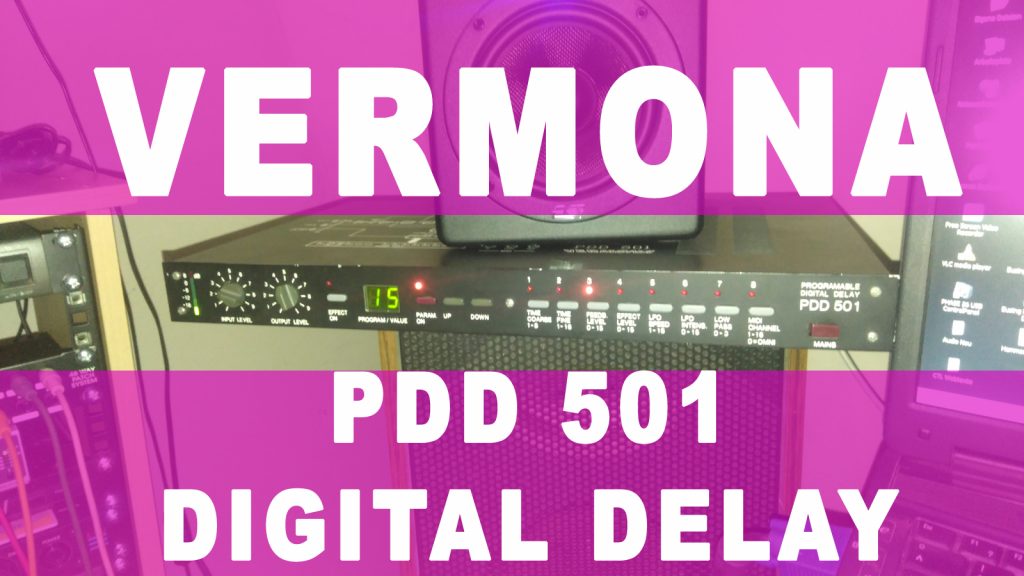
The late 1980s were a time of upheaval in music technology, as analog warmth increasingly gave way to digital precision. In this era, a device emerged that embodied this shift: the Vermona PDD501 Digital Delay . Originally developed and produced in East Germany, the PDD501 was not only a reliable effects unit but also an early pioneer in the democratization of digital sound processing.
I. Modernity in the textile industry: Design and technology
The PDD501 was released by VEB Klingenthaler Harmonikawerke (KHW) under the Vermona brand. While many contemporary devices still relied on analog circuitry or expensive, imported digital technology, the PDD501 offered a clear, digital alternative.
The move away from analog
The main difference to its predecessor, the Vermona DEG500 (an analog bucket-brigade delay), lay in the operating philosophy and the sound aesthetics:
- Digital precision: The PDD501 produced clean, clear repeats – free from the noise or the slowly decaying frequency response that analog delays typically exhibit.
- Pushbuttons instead of knobs: Instead of continuously variable potentiometers, the PDD501 used pushbuttons and digital displays . This was a “modern feature” at the time, enabling precise repeatability of settings – an advantage for live musicians and sound engineers.
- Easy to use: Despite its digital nature, the operation was intuitive and easily accessible, making it attractive to a wide range of musicians, from guitarists to studio users.
II. From the stage to the niche: The enduring popularity
Although the PDD501 was soon surpassed in technology by Western and Japanese manufacturers, it enjoys remarkable appreciation in certain circles today. It is not its flawless precision that makes it desirable, but rather its unique character and robustness .
The experimental appeal
The PDD501 is a popular tool in experimental and electronic music today . This is due to its special properties when used in combination with other effects:
- Clarity as a foundation: The relatively clean digital repetitions serve as a perfect, defined base. This is ideal if the delay sound itself shouldn’t become muddy before being distorted by subsequent effects.
- Effect combinations: Combining it with a phaser (which adds circular motion to the sound) or a spring reverb (which adds texture and a primitive, metallic spaciousness) creates sounds that stand out from the usual, clinically perfect VST plugins. The result is a distinctive, often raw and unique sound.
- Lo-fi aesthetics: For lovers of lo-fi sound and vintage electronics, the PDD501 offers an authentic sound that is often sought after for ambient, industrial or noise music.
The Vermona PDD501 is thus a fascinating relic of music history. It proves that even in an age of technological revolutions, a device can maintain a firm place in modern sound design through intelligent design and a unique sonic character . It is a classic that continues to break the rules of music.