
In the landscape of vintage drum machines, few instruments carry as much historical and sonic character as the Vermona ER9. Manufactured in the late 1970s and early 1980s by VEB Klingenthaler Harmonikawerke in the former German Democratic Republic (GDR), the Vermona ER9 Rhythm machine remains a hallmark of East German engineering. While Japanese manufacturers like Roland and Korg were dominating the Western market, Vermona created a distinct, fully analog rhythm box that has since found a second life in modern ambient and electronic music.
Sound Architecture and Instruments
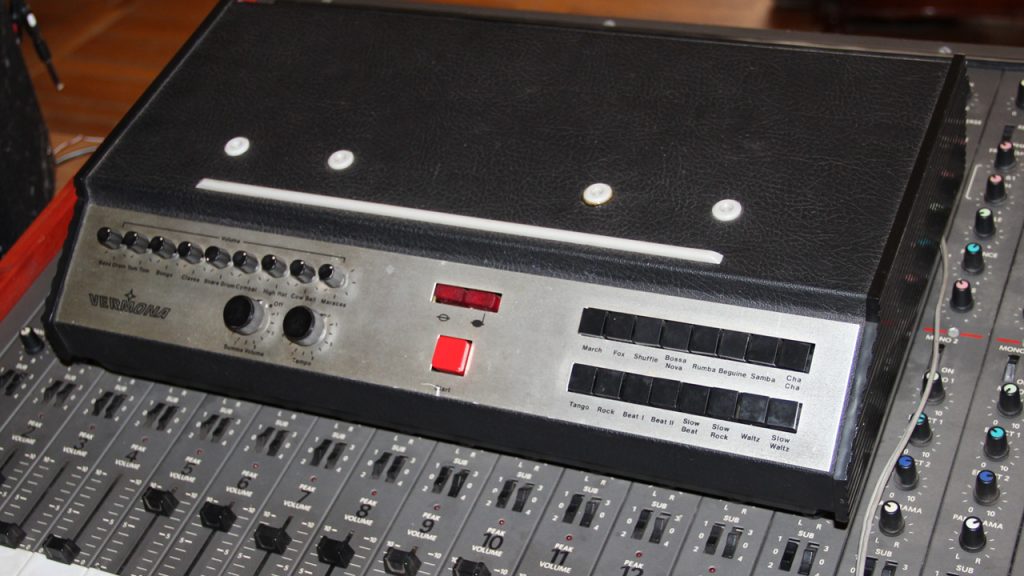
The Vermona ER9 Rhythm machine is a fully analog preset drum machine. Unlike the later Vermona DRM series from 1987 which allowed for extensive synthesis control, the Vermona ER9 was designed as a “backing band” for organists and solo entertainers. It features 9 percussive voices, each generated by dedicated analog circuits:
- Kick Drum: Deep and soft with a characteristic “clicky” transient.
- Tom-Tom & Bongo: Tuned resonant circuits providing organic, wooden tones.
- Snare Drum: A combination of a tuned oscillator and filtered white noise.
- Cymbal & Hi-Hat: Metallic, sharp textures using noise generators.
- Claves, Cowbell, and Maracas: High-frequency accents that define the “Salon” sound.
One of the ER9’s most professional features is the individual volume control for each instrument. While many preset machines of that era only offered a master volume, the Vermona ER9 allows the user to balance the mix or completely “mute” specific instruments by turning their dedicated potentiometers to zero.
Rhythms and Interface
The unit is equipped with 16 preset rhythm patterns, ranging from traditional ballroom styles to contemporary pop beats of the era:
- Traditional: Waltz, Slow Waltz, March, Fox, Tango.
- Latin: Bossa Nova, Rumba, Beguine, Samba, Cha-Cha.
- Modern: Rock, Beat 1, Beat 2, Slow Beat, Slow Rock, Shuffle.
A defining creative feature of the Vermona ER9 is the ability to combine rhythms. By pressing multiple preset buttons simultaneously, the internal logic gates overlap the patterns, creating complex, polyrhythmic textures that were never officially documented in the manual but became a favorite trick for experimental musicians.
Technical Specifications & Connectivity
The Vermona ER9 was built into a robust wooden or plastic-clad housing, reflecting the industrial design of the GDR.
| Feature | Specification |
| Synthesis Type | Pure Analog (Transistor-based) |
| Year of Release | Approx. 1976 |
| Patterns | 16 Presets (Combinable) |
| Instrument Count | 9 |
| Outputs | 5-pin DIN (Audio/Trigger) |
| Controls | Tempo, Master Volume, 9 Individual Voice Volumes |
Connectivity Note: The Vermona ER9 typically uses 5-pin DIN connectors for audio output, a standard common in European audio equipment of the 70s. Modern users often require a DIN-to-TS (Jack) adapter or a modification to integrate the machine into current studio environments.
The Modern Legacy
Today, the Vermona ER9 is sought after for its “warm” and “unpolished” lo-fi aesthetic. Its inability to sync to MIDI or DIN-Sync out of the box makes it a “performance” instrument that requires manual tempo matching, though many units are now retrofitted with kits (such as Tubbutec’s uniPulse) to allow for MIDI triggering and DAW integration.
For producers seeking the authentic “Salon” or “Palm Court” atmosphere of the 60s and 70s, the Vermona ER9 provides a rhythmic foundation that sounds inherently nostalgic yet remains technically fascinating due to its discrete analog circuitry.