
A Vermona synthesizer is an analog synthesizer that was manufactured in the GDR. It was produced in the 1970s and 1980s by VEB Vermona Musikelektronik.
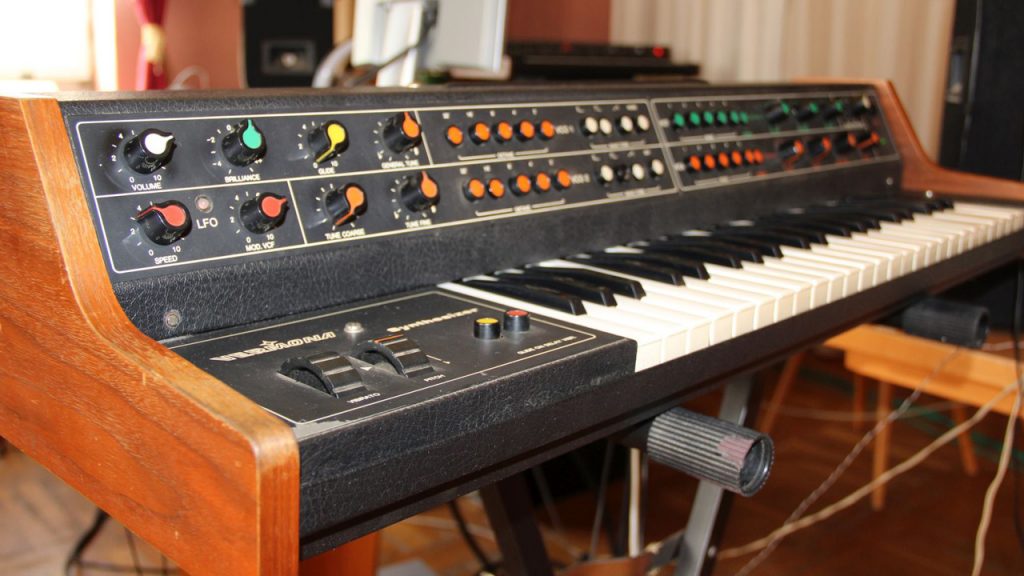
The Vermona synthesizer is a monophonic synthesizer; that is, it can produce only one note at a time. It features a range of oscillators, filters, and modulation sources that allow for the creation of various timbres.
The oscillators of the Vermona synthesizer can generate three different waveforms: sine, square, and triangle. The filter is a low-pass filter that attenuates the high frequencies of the sound. The modulation sources consist of an LFO (Low-Frequency Oscillator) and an ADSR envelope generator.
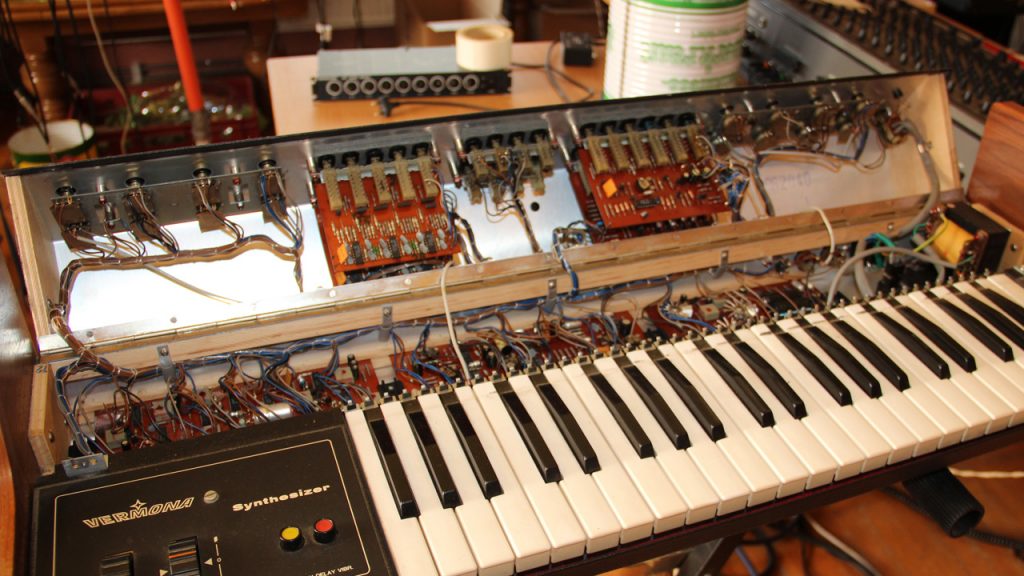
The Vermona synthesizer was used by musicians in East Germany and other parts of Eastern Europe. It was also popular with Western musicians looking for affordable analog synthesizers.
Here are some of the most well-known Vermona synthesizer models:
- Vermona Monophaser: A synthesizer with a phase-shifting effect.
- Vermona DRM1: A synthesizer with a digital sequencer.
- Vermona 14: A synthesizer with an analog filter.
Today, Vermona synthesizers are highly sought-after collector’s items. They are often used for music productions and live performances.
The Sonic Ambassador of the East: A Deep Dive into the 1983 Vermona Synthesizer
In the early 1980s, the global music landscape was being radically reshaped by the rise of electronic instruments. While Western musicians had ready access to legendary synths from Moog, Sequential Circuits, and Roland, musicians behind the Iron Curtain faced a starkly different reality. Import restrictions and severe currency shortages made Western gear nearly impossible to obtain.
Enter the Vermona synthesizer, released in 1983. Manufactured by the state-owned enterprise VEB Klingenthaler Harmonikawerke, this instrument became the definitive analog voice of the German Democratic Republic (GDR) and a fascinating chapter in synthesizer history.
1. Historical Context: The Sound of the Kombinat
To understand the Vermona synthesizer, one must understand its origin. Vermona was a brand name used by the VEB Kombinat Musikinstrumente Klingenthal in Saxony, a region with centuries of tradition in making accordions, violins, and brass instruments. Under the socialist economy, the collective was tasked with modernizing and producing electronic instruments for the Eastern Bloc.
When the Vermona synthesizer debuted in 1983, it wasn’t meant to be an avant-garde experimental machine; it was designed as an affordable, reliable, and versatile instrument for live entertainment musicians, dance bands, and state-funded studios. It was the GDR’s answer to the compact monophonic synthesizers of the West, most notably drawing comparison to the Minimoog and the Roland SH-series, though possessing a character entirely its own.
2. Design and Build Philosophy
The first thing that strikes you about the Vermona synthesizer is its utilitarian, rugged aesthetic. Built like a piece of laboratory equipment, it features a robust metal chassis with wooden side panels, weighing in at a hefty 12 kg.
The Control Panel
The layout is remarkably intuitive, adopting the classic left-to-right signal flow popularized by Western monophonic synths. The controls consist of heavy-duty plastic knobs and distinct colored rocker switches that are highly satisfying to operate.
The Keyboard
It features a 44-note keyboard (F to C). True to the budget and manufacturing constraints of the era, the keyboard does not feature velocity or aftertouch. However, it is highly responsive and built to survive the rigors of touring.
3. Technical Architecture & Sound Engine
The Vermona synthesizer is a fully analog, monophonic synthesizer. Its architecture relies on a traditional Subtractive Synthesis model, but the specific implementation of its components gives it a distinct “Eastern European” sonic fingerprint—warm, sometimes unstable, and wonderfully gritty.
Voltage Controlled Oscillators (VCOs)
The heart of the Vermona consists of two identical analog VCOs.
- Waveforms: Each oscillator can generate Sawtooth, Square, and Pulse waves.
- Tuning: They can be stepped across multiple octaves (from 32′ up to 2′) using rotary switches, with a “Fine Tune” knob on VCO 2 for creating rich, detuned chorus effects.
- Glide: A global Portamento (Glide) control allows for smooth pitch transitions between notes.
Mixer Section
The mixer allows you to blend the volumes of VCO 1 and VCO 2. Crucially, it also features a White Noise Generator, which is essential for synthesizing percussion, wind effects, and aggressive, industrial textures.
Voltage Controlled Filter (VCF)
The filter is where the Vermona truly shines. It features a 24 dB/octave low-pass filter, heavily inspired by the classic Moog ladder filter design, but built using Soviet-era components (like East German operational amplifiers).
- Controls: It offers standard controls for Cutoff Frequency and Resonance (labeled “Intensity”).
- Self-Oscillation: When pushed to its limit, the resonance will cleanly self-oscillate, allowing the filter to be used as a third sine-wave oscillator.
- Key Tracking: A switch allows the filter cutoff to track the keyboard pitch.
Envelopes (VCA & VCF)
The Vermona utilizes two independent envelope generators:
- VCF Envelope: A dedicated ADS (Attack, Decay, Sustain) envelope to shape the filter over time. A toggle switch allows you to invert the envelope, a great feature for complex modulation.
- VCA Envelope: A simpler ADR (Attack, Decay, Release) or basic gate envelope to shape the volume.
Low Frequency Oscillator (LFO)
For modulation, there is a single LFO capable of generating Frequency Modulation (Vibrato) or Pulse Width Modulation (PWM). It offers Sawtooth and Square waves, adding movement and animation to the raw oscillators.
4. The Vermona Sound: Sonic Character
The Vermona synthesizer does not sound like a pristine American polyphonic synth or a precise Japanese instrument. It is unpolished in the best way possible.
| Sonic Strengths | Ideal Genres |
| Deep, Earthshaking Basses (thanks to the 24dB filter) | Synthwave / Darkwave |
| Creamy, detuned leads | Progressive Rock / Kraftwerk-style Electro |
| Industrial / Sci-Fi FX (using the noise generator and self-oscillating filter) | EBM (Electronic Body Music) / Ambient |
Because the internal components fluctuate slightly with temperature, the synth possesses a “living,” organic drift. It excels at heavy, aggressive basslines and piercing, emotive leads.
5. Connectivity and Modern Integration
As a product of 1983 East Germany, the Vermona predates the widespread adoption of MIDI in that region. Standard factory units featured:
- 1/4-inch Mono TS Output (for amplifiers/mixers).
- Proprietary inputs for foot pedals to control filter cutoff or pitch.
Because it lacks factory MIDI or standard CV/Gate (Control Voltage) inputs, modern producers often have them retrofitted. Many specialized tech companies offer modifications to install MIDI-to-CV converters internally, allowing this 1983 beast to be easily sequenced by modern DAWs like Ableton or Logic Pro.
6. Legacy and Collectibility
When the Berlin Wall fell in 1989, many Eastern musicians rushed to swap their gear for Western instruments, and Vermona synths were temporarily forgotten or sold cheaply. However, decades later, the electronic music community rediscovered the unique charm of socialist-era analog gear.
Today, the 1983 Vermona synthesizer is a highly sought-after collector’s item. It stands as a testament to the ingenuity of the engineers in Klingenthal, who, despite severe material shortages and political isolation, managed to build an instrument with an undeniable soul. It remains a beautiful piece of cultural and musical history—a bridge of sound that spanned the Iron Curtain.
Technical Specifications Summary
- Release Year: 1983
- Origin: GDR (German Democratic Republic) / East Germany
- Manufacturer: VEB Kombinat Musikinstrumente Klingenthal
- Type: Monophonic Analog Subtractive Synthesizer
- Keyboard: 44 keys (F-C)
- Polyphony: Monophonic (1 voice)
- Oscillators: 2 VCOs + White Noise Generator
- Filter: 24 dB/oct Low-Pass Filter with resonance
- Weight: ~12 kg