
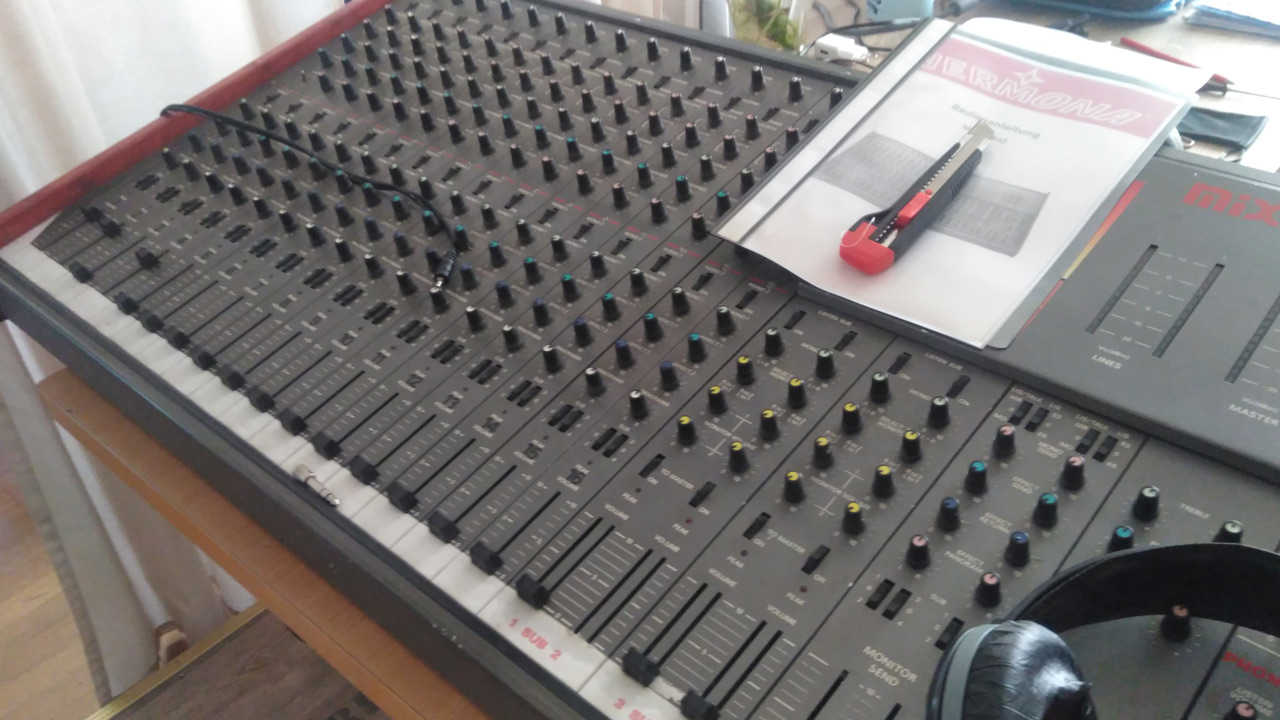
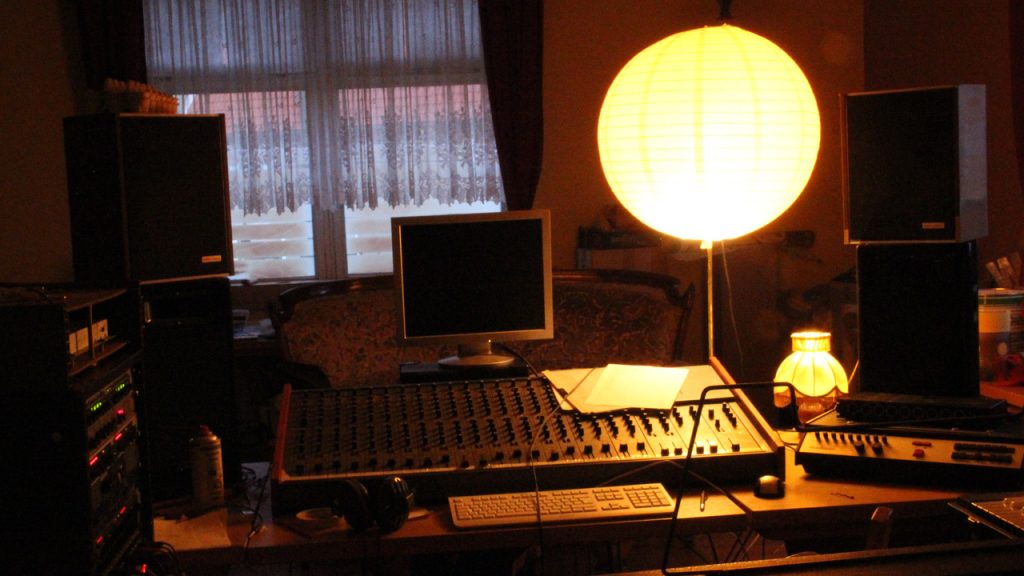
The Vermona Mixer 1642 represents the flagship of professional live and PA mixing consoles manufactured by the VEB Klingenthaler Harmonikawerke. Engineered for the demanding environment of touring bands and large-scale venue reinforcement, this desk marks the absolute pinnacle of analog audio technology from the late GDR era.
Technical Specifications
- Type: Analog 16-Channel Stereo Mixing Console with Subgroups
- Manufacturer: VEB Klingenthaler Harmonikawerke (GDR)
- Production Period: Mid to late 1980s
- Channel Architecture:
- 16 Mono Input Channels (Channels 1–16)
- 4 Stereo Subgroups (Subgroups 1–4)
- 2 Master Outputs (Main Left / Right)
- Channel Equalization: 3-Band EQ with semi-parametric Mid control
- Auxiliary Sends: 4 Sends per channel (2x Monitor, 2x Effect Send)
- Expandability: Expandable by an additional 8 channels to a total of 24 channels using the external EX 800 expander unit.
Circuit Design & Technical Features
1. The Input Stage (Input Transformers)
Every single one of the 16 input channels is equipped with a high-quality, physical input transformer (Type VI 01). This architecture allows for either fully balanced, floating signal routing or operation with the integrated phantom power (+12.6 V). Positioned directly after the initial gain stage is a dedicated phase inversion switch (realized via the VI 02 operational amplifier) to correct phase cancellation issues instantly at the desk.
2. The EQ Architecture (Wien Bridge)
Departing from simple high/low shelving designs, the 1642 features a fully sweepable semi-parametric midrange equalizer in each channel strip. This filter section is circuit-designed around a classic Wien Bridge network.
- Frequency Range: Continuously sweepable from 100 Hz to 4 kHz.
- Gain (Depth): Boost or cut of up to ±12 dB.
- This is complemented by fixed high-frequency (Treble) and low-frequency (Bass) shelving filters.
3. Signal Routing & Subgroups
The Mixer 1642 offers remarkably flexible routing capabilities for a console of its era:
- The stereo signal defined by the panoramic potentiometer can be routed to subgroups 1/2 or 3/4 via dedicated mechanical SUB switches.
- Each of the four subgroups features an independent Peak LED (overload indicator) and can be decoupled from the master bus, allowing for complex sub-mixes (e.g., routing an entire drum kit or a wall of synthesizers to just two faders).
4. Component Base (GDR Semiconductors)
The internal circuitry relies strictly on standardized Comecon (RGW) components. The low-noise A109 integrated circuit (the GDR equivalent to the Western \mu\text{A709} or LM709) serves as the primary operational amplifier throughout most of the signal paths. The front-end input transistors are built around the proven SC727 series.
Performance & Practical Character
While Western consoles of comparable size in the late 1980s were shifting toward highly integrated IC summing blocks, the Vermona 1642 remains a textbook example of modular, highly service-friendly design. By removing the bottom plate and the front profile, each individual channel strip can be pulled out vertically as an independent circuit board module.
Sonically, the console is heavily defined by its transformer-balanced inputs. It delivers a warm, solid, and exceptionally headroom-rich analog sound. The lo-fi “grit” found in older Vermona units is virtually absent here—this board was designed to meet international studio and live sound standards with high transparency.